entroly
Entroly — full benchmark evidence
This is the complete, uncut evidence behind the headline numbers in the README. Every result here links to a committed, reproducible artifact and states its scope, sample size, and limitations. Treat each result as evidence for that specific dataset, budget, model, and commit — not as a guarantee for another repository or workload.
entroly simulate uses a local token estimate. Use provider-observed usage
for a billing or production claim.
Context Commit conformance
Synthetic deterministic code fixtures, local, no model or network calls:
| Integrity property | Committed result |
|---|---|
| Deterministic replay across Python + Rust modes | 128 / 128 |
| Exact recovery of omitted chunks | 576 / 576 |
| Tamper mutations detected | 768 / 768 |
Reproduce: python -m benchmarks.context_commit_conformance.
Raw JSON. These numbers
measure artifact integrity, replay, and recovery on the committed fixtures;
they do not measure model-answer quality or claim identical Python/Rust selection.
Context Efficiency Frontier research
Entroly is building a paired, model-neutral benchmark for the question token-savings tables cannot answer: does less context preserve real task quality? The preregistered protocol compares raw context, model-native compaction, Entroly, and their combination using provider-observed tokens, cost, latency, task success, evidence recall, and unsupported claims.
Read the preregistered protocol. No headline result will be claimed until the paired confidence bounds pass.
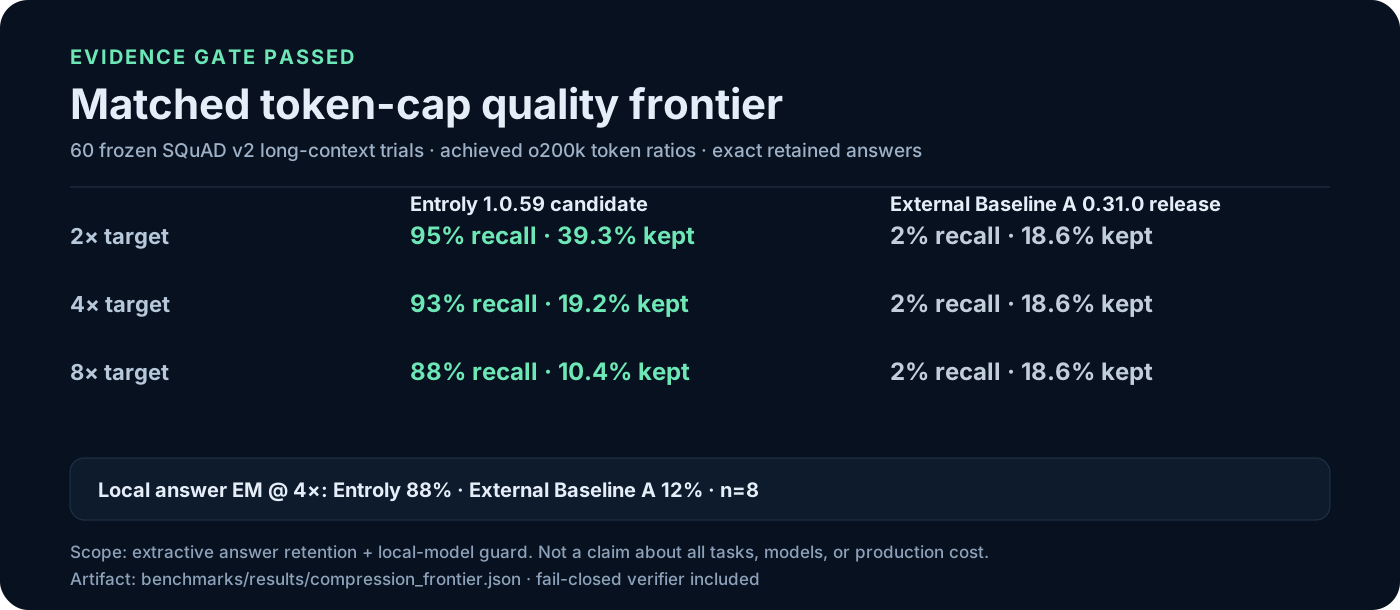
Matched token-cap active-context quality frontier (1.0.59 source candidate)
Across 60 frozen SQuAD v2 long-context RAG/tool-result trials, without invoking
recovery from the published External Baseline A 0.31.0 baseline’s CCR pointers, Entroly
retained 95.0%, 93.3%, and 88.3% of accepted answers at the 2x, 4x,
and 8x token caps. The published External Baseline A 0.31.0 baseline retained
1.7% at each cap. The paired two-sided exact McNemar tests pass at every
point (p <= 4.45e-16). Entroly met all 180 caps; the baseline met the 2x/4x
caps and exceeded the 8x cap, retaining 18.6% of tokens against the 12.5% maximum.
| Maximum token cap | Entroly answer retained / actual kept | Published External Baseline A 0.31.0 baseline |
|---|---|---|
| 2x (50%) | 95.0% / 39.3% | 1.7% / 18.6% |
| 4x (25%) | 93.3% / 19.2% | 1.7% / 18.6% |
| 8x (12.5%) | 88.3% / 10.4% | 1.7% / 18.6% (above cap) |
A separate eight-question, randomized local qwen2.5:1.5b guard at 4x scored
raw context at 62.5% exact match, Entroly at 87.5%, and the published
External Baseline A 0.31.0 baseline at 12.5%, with no errors. This small local-model sample
is a veto guard, not the headline or a frontier-model claim.
Generated report ·
full auditable artifact ·
protocol and reproduction. Verify it
with python -m benchmarks.compression_frontier verify benchmarks/results/compression_frontier.json.
Scope: extractive answer retention in structured SQuAD-v2 RAG results. The published External Baseline A 0.31.0 baseline’s CCR pointers remain in its output, but retrieval recovery is not run; this measures immediately visible active context, not External Baseline A’s end-to-end CCR workflow. Entroly is measured from the 1.0.59 source candidate; do not call this a released-package result until 1.0.59 is published. This does not establish superiority for every task, model, compressor, or production workload.
Same-input compression gauntlet
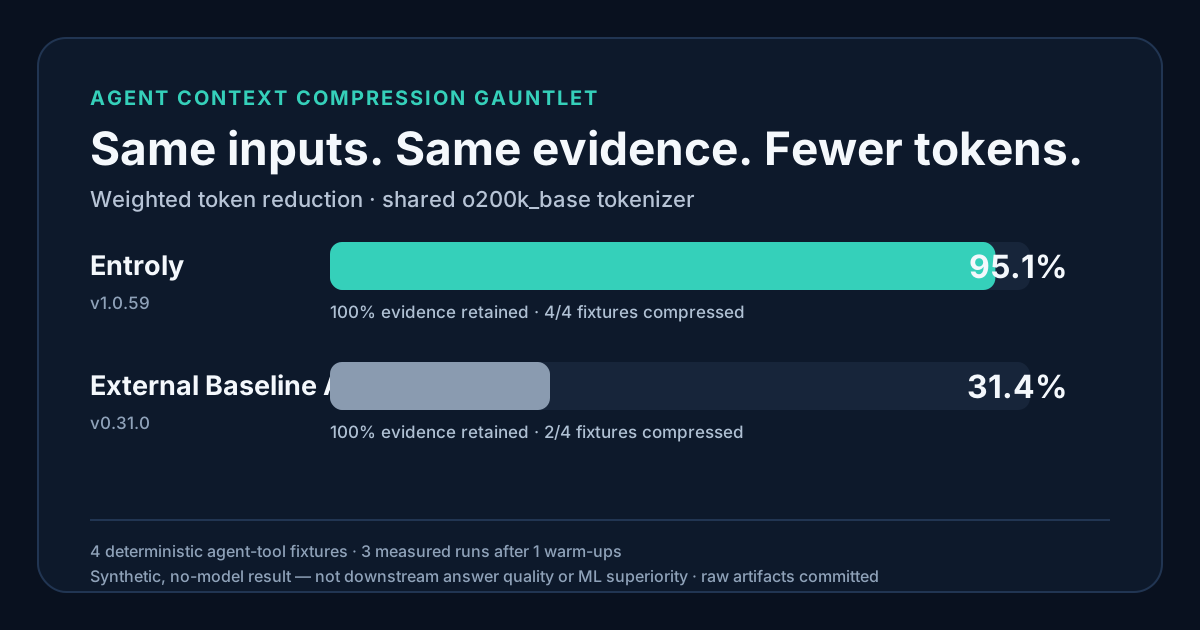
On four deterministic agent-tool fixtures, current Entroly source (package
version 1.0.59) and the published External Baseline A 0.31.0 baseline both
retained 100% of the preregistered answer evidence. Under the shared
o200k_base tokenizer, Entroly reduced weighted input tokens by 95.1%
versus 31.4% for the baseline’s public compress() pipeline with its
documented agent-90 high-savings profile. Entroly compressed all four
fixtures; the baseline compressed two and safely passed two through.
Generated report ·
raw inputs and outputs ·
protocol and reproduction. Verify the
artifact with python -m benchmarks.compression_gauntlet verify benchmarks/results/compression_gauntlet.json.
This is a synthetic, no-model compression/evidence result. It does not measure downstream answer quality or establish neural/ML superiority. The Context Efficiency Frontier above is the required gate for a real-model claim.
Cross-process recovery holdout
The preregistered six-writer test first exposed a serious Entroly failure (only 8/32 development payloads survived), which is preserved in the evidence. The original Entroly 1.0.59 holdout and the immutable v2 revalidation both recorded Entroly and the published External Baseline A 0.31.0 recovering 66/66 payloads. On the fresh-seed v4 revalidation of the current complete-line recovery implementation, both Entroly and the published baseline recovered 66/66 byte-exactly — both satisfied the frozen integrity gate. An earlier v3 run recorded a single transient competitor store-lock failure (55/66) that a clean re-run did not reproduce, so this is parity; it does not establish universal recovery superiority.
On the current-implementation Windows/Python 3.10 revalidation, the published
External Baseline A 0.31.0 baseline had lower successful store-call latency
(1.524 ms versus 34.848 ms p50). Entroly had lower retrieval latency (0.059 ms
versus 0.441 ms p50) and a smaller live state footprint (95,438 versus
1,626,736 bytes). The baseline used SQLite WAL with synchronous=NORMAL;
Entroly fsynced its state file on each commit, so this is not a matched
power-loss durability comparison. These are scoped workload measurements, not
universal claims.
Frozen protocol and full result table | current v4 revalidation | prior v2 tie | original post-repair holdout | original failing artifact.
Quality-gated compression latency holdout
On the same four deterministic agent-tool fixtures and public entry points as the gauntlet, Entroly 1.0.59 source was 2.94x faster than the published External Baseline A 0.31.0 baseline for warm compressor calls (95% bootstrap CI 2.74x–3.13x) and 2.39x faster for product import plus the first call in a fresh process (1.89x–2.70x). Both systems completed every fixture, retained 100% of preregistered evidence, remained deterministic, and never inflated tokens.
Protocol, per-fixture timings, and limits | full holdout artifact | development artifact.
Scope: Windows/Python 3.10, synthetic local compression, 120 warm and 40 cold observations per participant. Cold excludes interpreter startup and includes product import plus first call. This is not provider latency, downstream answer quality, neural superiority, or universal product superiority.
Model-triggered recovery holdout
After compression for one question, a different future audit question was
revealed to a local qwen2.5:1.5b guard. On 24 frozen query-shift cases, raw
context and Entroly both scored 24/24 exact; the published External
Baseline A 0.31.0 baseline scored 18/24. All six paired differences
favored Entroly (two-sided exact McNemar p = 0.03125). Entroly’s mean
effective context ratio, including recovery evidence on every triggered
retry, was 28.88% versus 42.97% for the baseline.
Every Entroly row triggered retrieval and recovered a complete source-exact JSON object. The published baseline answered 18 rows from active context; its remaining six rows were scored under the frozen no-oracle retrieval rule. The raw artifact retains every response. The complete artifact passed the strengthened verifier with zero execution errors.
Protocol, rejected variants, reproduction, and limits | full holdout artifact | development artifact.
Scope: synthetic 48-record JSON audit logs, Windows/Python 3.10, 24
holdout cases, local Qwen2.5 1.5B Q4_K_M at temperature zero. The published
External Baseline A 0.31.0 baseline uses its public compress() plus
persistent CompressionStore contract; MCP transport is excluded. This is a
scoped workflow result, not evidence about hosted frontier models, every
agent workload, provider cost, or overall product superiority.
PRISM-R neural research preview
Frozen evidence-selection benchmark. A generic MiniLM encoder did not beat
BM25 as a primary paragraph scorer (97.7% versus 99.0% held-out evidence
recall; paired exact McNemar p=0.21875), so Entroly rejects that
neural-primary claim. A disagreement guard kept the answer-bearing passage in
298 of 300 cases while selecting an average of 1.02 of 16 passages. This
experiment measures retrieval of the paragraph containing a known answer; it
does not measure generated-answer quality. In a separate 200-pair query-shift
pilot at a nominal 25% active budget, PRISM-R retained 87.0% of current-query
evidence versus lexical selection’s 60.5%; when a different future question
was revealed, exact receipt-backed rehydration raised its evidence retention
from 9.0% to 90.5%. Active plus recovered context was 50.6% of the original.
Retrieval protocol and limits · Research design and prior art · held-out retrieval artifact · query-shift artifact.
These are offline exact-evidence pilots on frozen SQuAD v2 subsets. They do not measure generated answers and are not downstream answer-quality, latency, production-savings, or general neural superiority claims. PRISM-R is an opt-in research prototype, is not reachable from a shipped entry point, is not the default compressor, and remains opt-in research code.
Accuracy retention
Does compression hurt answers? Measured with gpt-4o-mini; intervals are
Wilson 95% CIs. Each row links its raw result file.
| Benchmark | n | Budget | Baseline | With Entroly | Retention | Token savings |
|---|---|---|---|---|---|---|
| NeedleInAHaystack | 20 | 2K | 100% | 100% | 100% | 99.5% |
| LongBench (HotpotQA) | 50 | 2K | 64% | 66% | 103% | 85.3% |
| Berkeley Function Calling | 50 | 500 | 100% | 100% | 100% | 79.3% |
| SQuAD 2.0 | 50 | 100 | 80% | 72% | 90% | 43.8% |
| GSM8K | 20 | 50K | 85% | 85% | 100% | pass-through* |
*pass-through: context already fit the budget, so Entroly left it unchanged. Reproduce: python benchmarks/run_readme_benchmarks.py (needs OPENAI_API_KEY). Scope, additional artifacts, and limitations are in the public evidence ledger.
Hallucination detection
Committed HaluEval-QA balanced, both-answers-scored run:
| Result | Decisions | Accuracy | AUROC | Scope |
|---|---|---|---|---|
| WITNESS full benchmark | 20,000 | 84.92% on the 16,000-decision held-out split | 0.7976 | Local, deterministic verifier |
| WITNESS on the shared GPT sample | 1,200 | 86.58% | 0.8132 | Same sampled decisions used for the GPT rows |
| gpt-4o-mini on the shared sample | 1,200 | 86.25% | not reported | API judge comparison only |
Reproduce: python benchmarks/halueval_qa_faithful.py.
Protocol and raw result. The
shared-sample accuracies overlap within their reported uncertainty; this result
does not establish superiority, general hallucination prevention, or production
answer quality. The separate STAVE exploratory result
is not used for the headline because it follows a different evaluation setup.
Proof-in-30-seconds videos
Three short, reproducible checks show the value before asking you to trust the product. These are not mocked terminal recordings: each video is rendered from a checked-in command that verifies its source artifact before printing a number.
1. The installed path works — without an API key
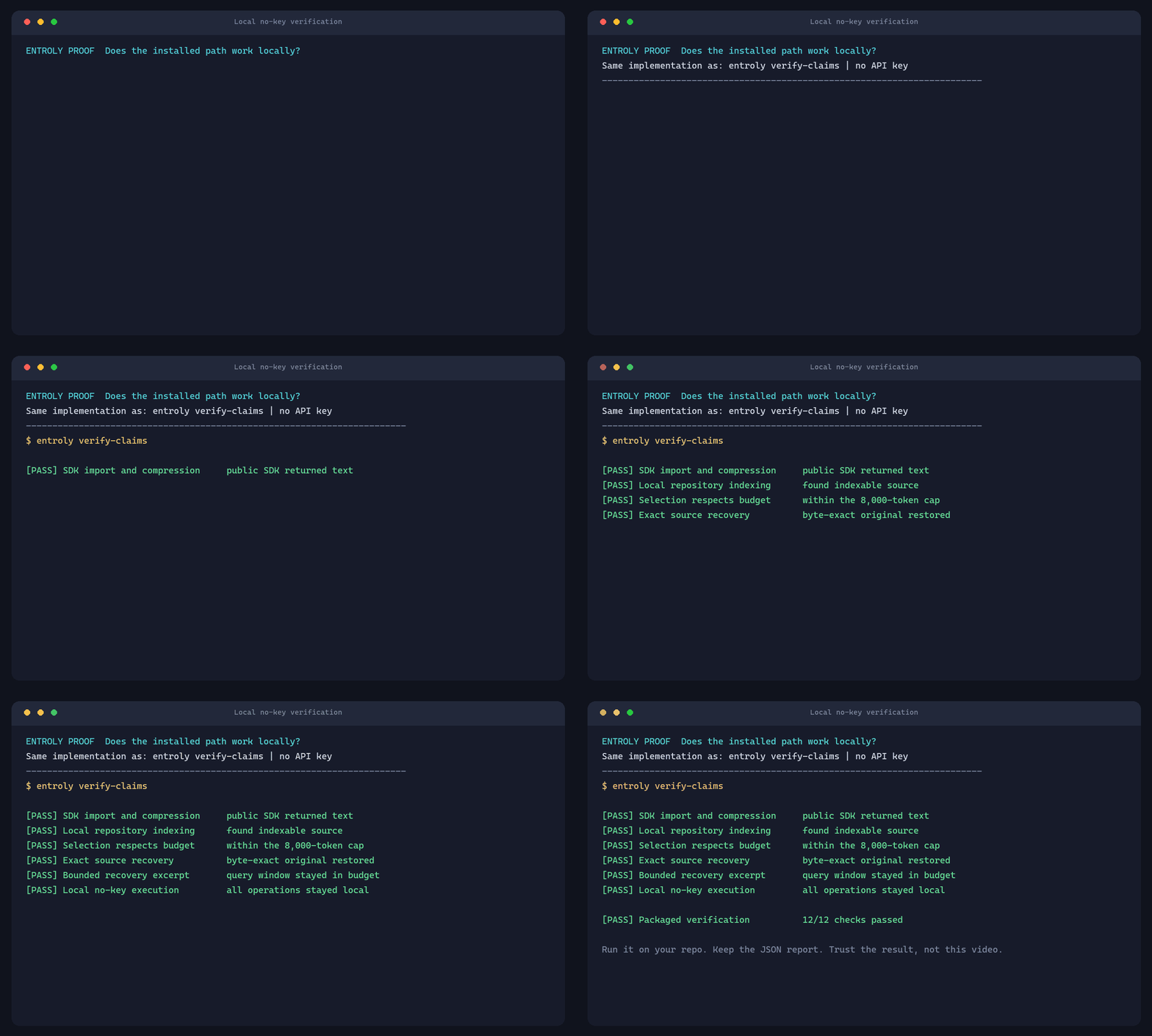
entroly verify-claims
2. Tighter context can preserve more answers
Using External Baseline A today? Run Entroly against the same workload and compare answer retention, recoverability, state size, and context cost locally. The results below use the published External Baseline A 0.31.0 package as a versioned baseline; they are not a verdict on every External Baseline A or Entroly workload.
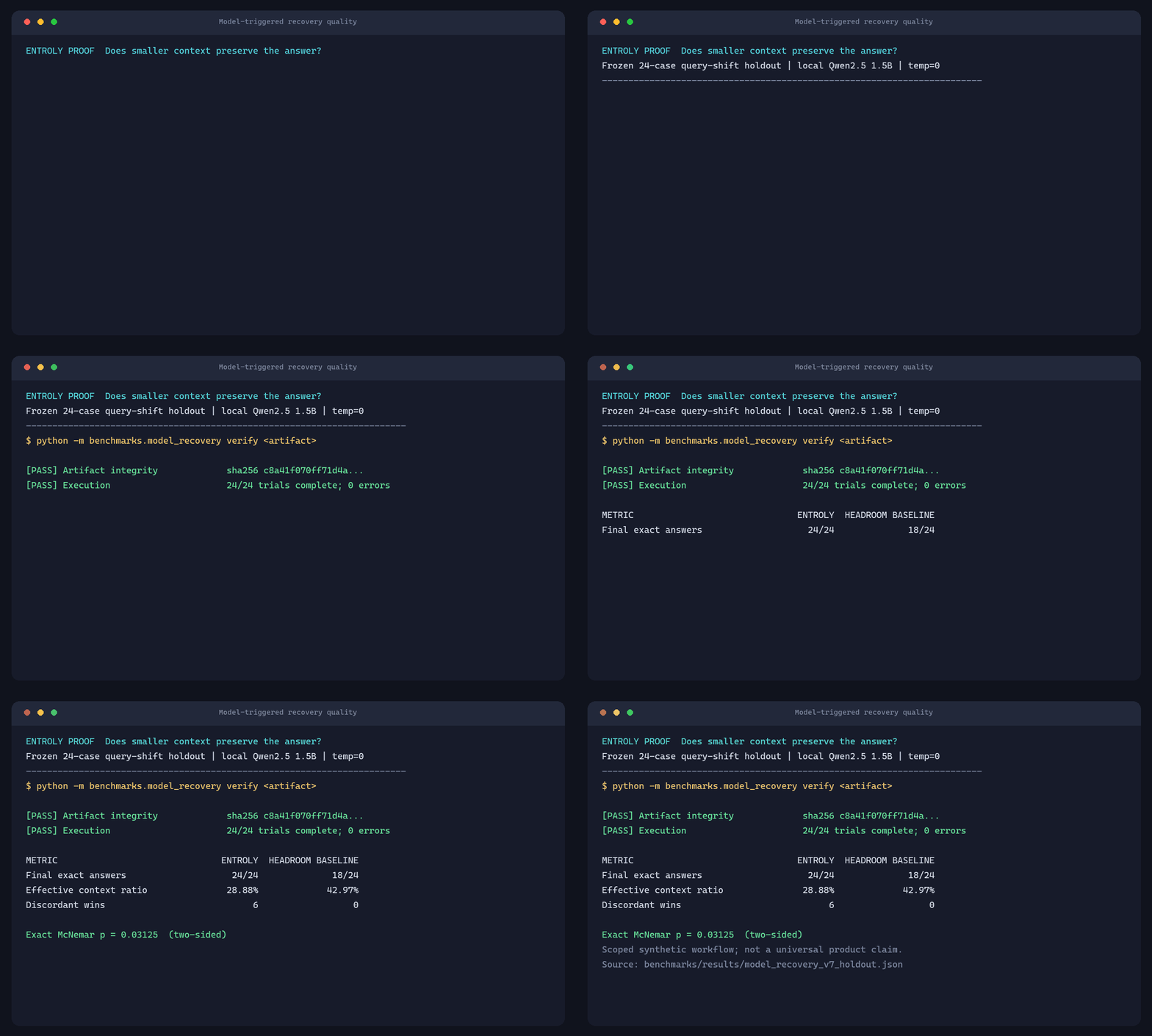
On the frozen 24-case holdout, Entroly answered 24/24 cases; the published
External Baseline A 0.31.0 baseline answered 18/24, at 28.88% versus
42.97% effective context. This is a synthetic local Qwen2.5-1.5B test at
temperature 0, not a universal product or model claim. The six discordant
cases favored Entroly (exact McNemar p=0.03125).
python scripts/readme_proof.py model-recovery
3. Omitted evidence remains recoverable after restart
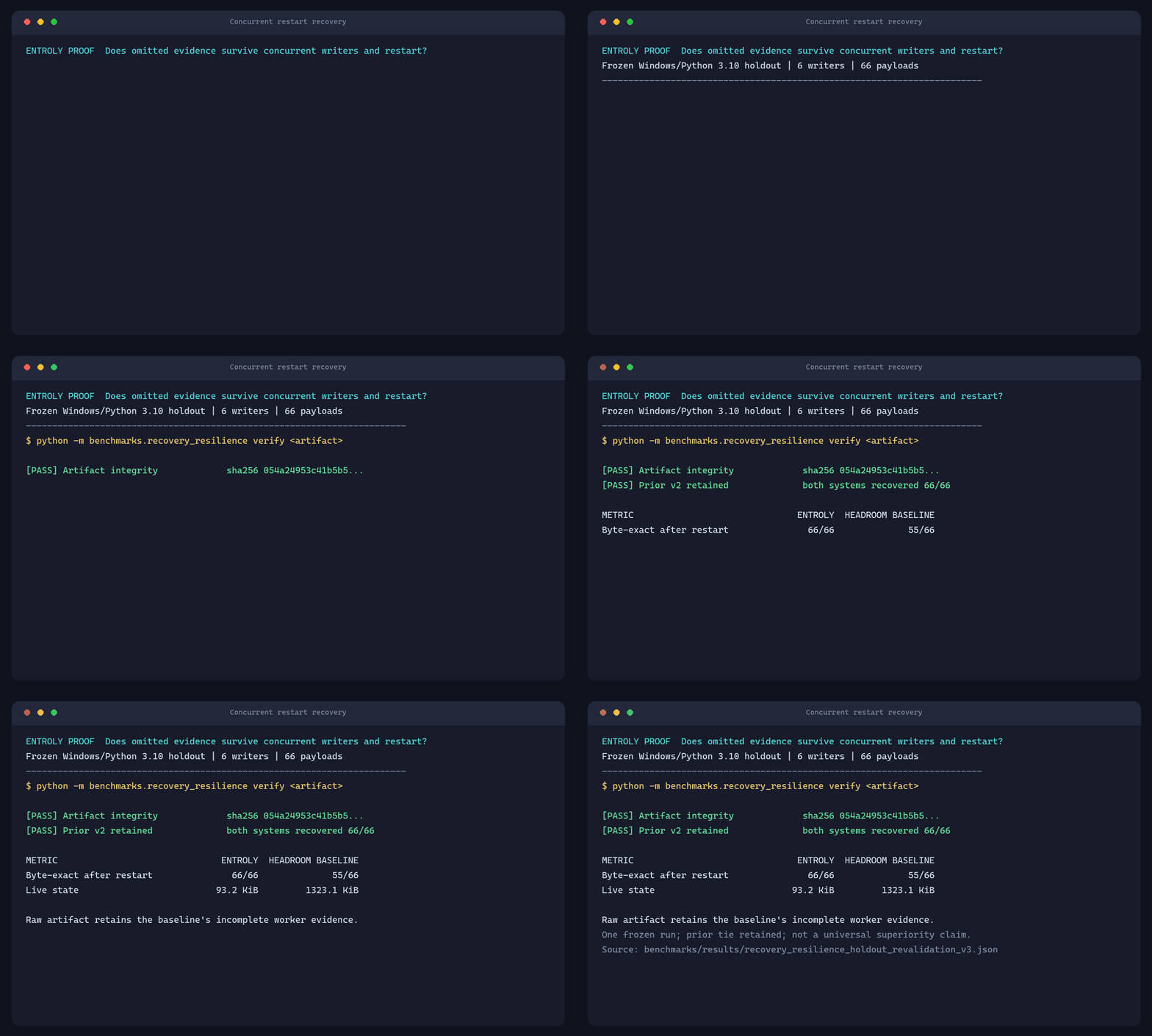
The prior v2 run tied at 66/66 and remains published. In the fresh-seed v4 Windows revalidation, both Entroly and the published External Baseline A 0.31.0 baseline recovered 66/66 payloads byte-exactly after restart — both satisfy the recovery-integrity gate. This is parity, not leadership: an earlier v3 run recorded a single transient competitor store-lock failure (55/66) that a clean re-run did not reproduce. This is one reproducible run, not a universal durability claim.
python scripts/readme_proof.py restart-recovery
The animations, MP4s, static frames, source hashes, and commands are bound in
the proof media manifest. Maintainers can
rebuild them with python scripts/render_readme_proof_videos.py generate and
reject stale media with python scripts/render_readme_proof_videos.py verify.
Rebuilding requires Pillow, tiktoken, and FFmpeg; a missing frozen-tokenizer
dependency fails with an actionable install command instead of weakening the
artifact check.
Verifying source-integrity yourself
Context reduction is dangerous when a tool silently changes source text. An
Entroly Context Receipt records the exact source-file SHA-256, UTF-8 byte
range, and fragment SHA-256 for both selected and omitted source fragments. A
receipt holder can recompute those values with hashlib; verification does
not call Entroly’s hash implementation.
On a pinned, unsampled corpus of 1,104 files in 13 languages, the installed native path produced 5,117 / 5,117 fragments whose text, source range, source digest, and fragment digest all verified. The pure-Python fallback independently passed 11,986 / 11,986 fragments. Through the public SDK, 13 / 13 omitted fragments recovered from two pinned source files matched their recorded source bytes and exact receipt-owned digest.
These are deterministic source-integrity checks, not generated-answer accuracy, retrieval recall, latency, or provider savings. The full artifacts contain the denominators, per-file hashes, exclusions, implementation commit, harness hash, limitations, and checksum sidecars.
python -m benchmarks.receipt_fragment_fidelity verify benchmarks/results/receipt_fragment_fidelity_default.json
python -m benchmarks.receipt_fragment_fidelity sdk-verify benchmarks/results/receipt_public_integrity.json
Inspect the exhaustive artifact · inspect the public-SDK probe · see the capability-to-proof map · submit a counterexample